

№ 01
Discovery call
Free 30 min
We look at your workflow, your current prototype, and what "working" means for you. You leave with a clear yes/no on whether a sprint fits. No pitch deck.
I'm a forward-deployed engineer for teams shipping AI agents. I work inside your repo and your cloud to take one agent or workflow from prototype to a governed pilot: real integrations, an eval set, guardrails, tracing, a cost ceiling, and a handover your engineers can own. I also created OunceMCP, an open-source framework for AI agent tool servers.
Best for teams of 10–300 people with a working prototype, a named owner, and a deadline.
8+ years shipping cloud and AI systems on Azure, AWS and GCP
Co-architected an enterprise platform running thousands of concurrent agents
Migration agent: 500K-line .NET Framework → 65K-line .NET 8 in 4.5 hours, 100% of tests passing
SEBI document Q&A with citations and per-answer cost
Try the demo ↗Over the past 8+ years I've designed, shipped, and operated production systems — most of them at the intersection of cloud-native infrastructure and agentic AI. Currently at Virtusa, I lead engineering teams and partner directly with enterprise clients to build agentic platforms where thousands of concurrent autonomous agents execute with strong evaluation harnesses, self-monitoring agents, and end-to-end observability.
Day-to-day I write Python, C#, and TypeScript, with Go and Rust in the toolbox, architect systems across Azure AI Foundry, AWS, and GCP, and care a great deal about the boring parts — evaluation harnesses, retries, schemas, and cost. I write here because writing is how I think; I take consulting work because production is where systems prove themselves.
Off-screen: long-form blogging, slow coffee, and an unreasonable interest in old typography.
Four years running in the DevTools cohort — recognized by AWS for deep-dive writing & talks on serverless, IaC, and the developer tooling that makes cloud-native work less painful.
Most agent projects don't fail at the model. They fail at the integration, the missing eval set, the cost nobody tracked, and the first real user who does something unexpected. Every package below is fixed in scope and price, has one measurable outcome, and runs inside your environment. You keep the code.
Written one-page scope before we start. No surprise invoices.
Agreed in writing on day one, e.g. "cut manual handling of this queue from 90 to 15 minutes."
Scoped credentials, least-privilege access, NDA on request.
On sprints, a go/no-go checkpoint at the midpoint. If we stop there, you pay only the first half.
Architecture notes, runbook, eval suite, and a recorded walkthrough.
Free 30 min
We look at your workflow, your current prototype, and what "working" means for you. You leave with a clear yes/no on whether a sprint fits. No pitch deck.
$250 90 min
A paid working session with your engineers on one hard problem: agent loops, retrieval quality, eval design, model routing, cost blowouts, or an MCP integration. Includes a written summary with recommendations within 48 hours.
Additional advisory time: $150/hour, billed in 1-hour blocks.
$2,500 One weekend
For teams unsure whether their agent is ready for real users.
The full fee is credited to any sprint booked within 30 days.
$8,000 fixed 4 weekends
One agent or workflow from prototype to a governed pilot.
| Weekend | Focus | You end up with |
|---|---|---|
| 1 | Scope and baseline | Workflow chosen, metric agreed, baseline measured, access in place |
| 2 | Integrate and instrument | Agent wired to your system, tracing live. Go/no-go checkpoint |
| 3 | Evaluate and guard | Eval set passing, guardrails and approval flow working |
| 4 | Pilot and hand over | Pilot running, results report, handover session done |
Sprint Plus
Same as above, plus a second integration or a multi-agent setup (planner, worker, critic), and two weeks of post-pilot tuning.
$6,000 fixed 3 weekends
For teams that have an agent in production but can't tell whether it's getting better or worse.
$8,000 fixed 4 weekends
One OpenAI-compatible endpoint for every team and agent, on Azure API Management, AWS or your existing gateway.
from $10,000 4–6 weekends
An AI migration agent pointed at one bounded module of your legacy codebase (e.g. .NET Framework → .NET 8), with automated tests as the acceptance gate.
Final price is set after the diagnostic, because it depends on codebase size and test coverage.
$1,500 /month 3-month minimum
For agents built in a sprint (by me or your team).
$4,500 /month ~32 hrs/month
A senior forward-deployed engineer on your team for ongoing agent work: architecture reviews, building features, reviewing your engineers' PRs, and joining one weekly call. Month to month after the first three months.
| Package | Price | Time |
|---|---|---|
| Discovery call | Free | 30 min |
| Architecture Advisory Session | $250 | 90 min |
| Agent Readiness Diagnostic | $2,500 (credited to a sprint) | 1 weekend |
| Production Agent Sprint | $8,000 | 4 weekends |
| Sprint Plus | $12,500 | 6 weekends |
| Eval & AgentOps Sprint | $6,000 | 3 weekends |
| LLM Gateway Sprint | $8,000 | 4 weekends |
| Legacy Modernization Agent Pilot | from $10,000 | 4–6 weekends |
| Agent Care | $1,500/month | 3-month minimum |
| Fractional FDE | $4,500/month | ~32 hrs/month |
All prices in USD, excluding taxes. Clients based in India: INR pricing on request.
Created and maintain an open-source Python framework for MCP servers. Across 4 models and 840 benchmark runs: 58–85% fewer tokens per task on large results, and every unauthorised write refused.
AI agents pay for every tool definition and every raw tool result in their context window. Most MCP servers also trust the model with writes and permissions: a retried call can run twice, an action the user declined can still go ahead, and one team’s data can end up in another team’s answer.
OunceMCP is an open-source Python framework (Apache-2.0, Python 3.11–3.13) on FastMCP 4.x and the official MCP Python SDK, targeting the MCP 2026-07-28 specification. Every tool result fits a token budget and still matches its output schema: lists are trimmed first, the agent gets a note on what was cut, and signed pagination cursors move so no item is skipped or repeated. The ouncemcp check command counts each tool definition the way the host receives it and fails CI when one goes over budget. When the catalog gets too large, the server switches to search-then-call discovery. OunceServer.wrap() adds all of this to an existing FastMCP server without changing its tools, and ouncemcp audit measures any MCP server. Around it: a CLI (init, dev with hot reload, check, context, audit, eval, bench, trace), an eval kit with replay and real-model runs, an HTML trace viewer, OpenTelemetry export, Prometheus metrics, health and readiness endpoints, and Redis-backed shared state for multiple replicas.
The server enforces safety; the prompt does not. Every tool declares its effect. Idempotent writes run once even when the model retries, and a write that times out is reported as ambiguous rather than failed. Risky actions wait for human approval through signed, single-use receipts bound to the exact tool, arguments and caller. Identity comes only from the verified token, one policy covers both listing and calling tools, and a client broker joins many MCP servers into one catalog without giving any server authority over another. 29 RFC-style design proposals record these decisions.
Published benchmark: two example servers against plain FastMCP equivalents, 4 models (Claude Haiku 5.5, Claude Sonnet 5.5, GPT-5.4 mini, DeepSeek V4.1 Flash), 21 tasks, 840 runs, with success judged on outcomes. On the server with large results: 58–85% fewer tokens per task, lower cost for every model, and 100% task success against 75–100% (one model miscounted when reading the large raw results). On the server with writes, every model on the plain server closed a ticket the user had not confirmed, deleted one without permission and showed another team’s ticket. OunceMCP refused all three in every run: 100% success against 68–70%.
Tool definitions are about 1.8–2.4x larger, so small servers with small results use more tokens per task. The write-up publishes this next to the wins.
Per-tenant cache partitioning, a token-passthrough guard, SSRF-safe outbound fetches (private and cloud-metadata addresses refused, connections pinned, redirects re-checked), signed expiring state and error redaction. An internal security audit found and fixed one high-severity issue and several smaller ones, each with a regression test. About 864 automated tests, the official MCP conformance suite as a required CI gate, CodeQL, pip-audit, Bandit and zizmor checks, and every CI action pinned to a commit SHA. Releases go to PyPI through trusted publishing (no stored tokens) from a protected, approval-gated environment; version tags cannot be moved or deleted. The docs include The OunceMCP Book, a 15-chapter tutorial where every code stage is a tested file.
The 1.0 API is frozen at the current release candidate. An external security review is the last step before the 1.0.0 release.
GitHub repo ↗Docs ↗PyPI package ↗The OunceMCP Book ↗Benchmark write-up ↗
Designed and shipped a multi-agent research system that drafts memos, validates sources, and surfaces uncertainties — operated by 40+ analysts daily.
An asset manager wanted internal analysts to draft research memos with model assistance — but their first attempt was a chat bolted onto a backend, and the analysts didn't trust it.
A four-agent system with explicit memory contracts: a planner, a retrieval agent over their internal corpus, a critic, and a drafter. Every agent step is logged with the inputs it actually saw; eval is continuous, not a launch-day ritual.
Adoption hit 40+ daily users in eight weeks. Memo first-draft time dropped from a half-day to roughly 25 minutes; analysts kept editorial control end-to-end.
Rebuilt a legacy ERP backbone as an event-driven, function-first system. Zero-downtime cutover, 62% lower run cost.
A 14-year-old monolithic ERP was the backbone of a manufacturing operation. The vendor had stopped updating it; the on-call burden had not.
An event-driven core on AWS — EventBridge plus orchestrated Step Functions for the long-running flows. Strangler-fig migration over six months, with a shadowing layer reading from both systems before each cutover.
Zero-downtime cutover across six modules. Run-cost dropped 62%. P95 order-processing latency improved from minutes to single-digit seconds.
End-to-end training to inference for a 5-person ML team without the hyperscaler overhead.
A five-person ML team needed real CI/CD for models, but didn't have the headcount to maintain a hyperscaler-grade platform.
An MLflow + Argo + Harness stack tuned for small teams: artifact discipline by default, shadow deployments before promotion, and a retraining trigger driven by drift detection rather than a calendar.
Two production models retrained autonomously over twelve months with no on-call escalations attributable to the pipeline itself.
Schema-aware streaming with deterministic replay, cutting incident recovery from hours to minutes.
An ad-tech platform was losing thousands of dollars per minute during stream incidents because replay required guesswork on schema versions.
A schema-registry-backed streaming pipeline where every record carries the version it was written with, and consumers know how to evolve it forward. Deterministic replay built on top.
Mean-time-to-recovery dropped from ~3.5 hours to ~12 minutes. The schema review process became a normal PR rather than a launch-day fire drill.
A small library of Harness templates for ML and Python services. ★ 240, 9 contributors.
I kept rewriting the same Harness pipelines from scratch on every engagement. So I extracted the patterns I trusted into a small, opinionated library.
Templates for Python services, ML models with shadow deployments, and the boring-but-essential parts: secrets, approvals, rollbacks. Documented on the assumption you've never used Harness before.
★ 240 on GitHub, 9 outside contributors, used by ~30 teams I know about.
Hybrid serverless + GPU pipeline that diarizes interview audio with Pyannote, then RAGs the transcript into a PDF report with timestamped proof of malpractice.
Interview platform needed evidence-grade detection of cheating during live remote interviews — multiple voices, prompts being read off-screen, third-party assistance. A raw transcript was not enough; reviewers needed who said what, when, and why it counted as malpractice.
A hybrid pipeline: Cloud Run handles ingest, audio extraction from video, and pre-processing on serverless. The diarization step — Pyannote — runs on a containerized GPU instance, since the model is too heavy for serverless cold-starts. Speaker-labeled segments with timestamps flow into a RAG pipeline on Vertex AI Studio, which retrieves policy context and generates a structured report. A PDF render step attaches the offending audio clips as proof inside the report.
Cloud Run keeps ingest cheap and elastic for spiky interview volume. The GPU container stays warm only for the inference window — diarization is the expensive step and the only one that needs accelerators. Splitting the two cut idle cost while keeping P95 turnaround under three minutes per interview.
Reviewers stopped scrubbing full recordings — they jump straight to the flagged timestamps with grounded citations. False-flag rate dropped because the RAG step grounds verdicts in the platform’s own malpractice policy rather than free-form LLM judgement.
Co-architected an enterprise-grade agentic platform that runs thousands of concurrent long-running agents, with an AgentOps observability sidecar, a governed model release process, and an autonomous self-monitoring agent.
Enterprise engineering teams needed a unified, production-grade platform to deploy and run thousands of specialized autonomous agents reliably — without each team reinventing orchestration, evaluation harnesses, or runtime telemetry.
An end-to-end enterprise Agentic Platform built in Python and C# on Azure AI Foundry and Microsoft Agent Framework (MAF). Thousands of long-running agents run concurrently with strict per-agent data isolation. An LLM Gateway on Azure API Management gives every agent one OpenAI-compatible endpoint, with multi-model routing by cost, latency, and capability, automatic failover, semantic caching, token-based rate limiting, PII and content-safety guardrails, and per-team cost attribution. A legacy code migration agent, connected through Model Context Protocol (MCP) servers, autonomously migrated a 500K-line .NET Framework codebase to 65K lines of .NET 8 in 4.5 hours with zero human intervention, passing 100% of automated integration, end-to-end, and smoke tests. An AgentOps sidecar traces every agent request, response, and execution step. Agents are validated in an isolated sandbox, then promoted through governed environments to production. Models ship through a Model Release Process with versioning, evaluation gates, and governance approvals. Infrastructure is Terraform modules and CI/CD pipelines across Azure subscriptions on a hub-and-spoke network.
Designed an autonomous Self-Monitoring Agent that collects platform and agent telemetry every 5 seconds, detects anomalies, raises alerts, and triggers automated self-healing remediation — keeping multi-agent workloads healthy without manual intervention.
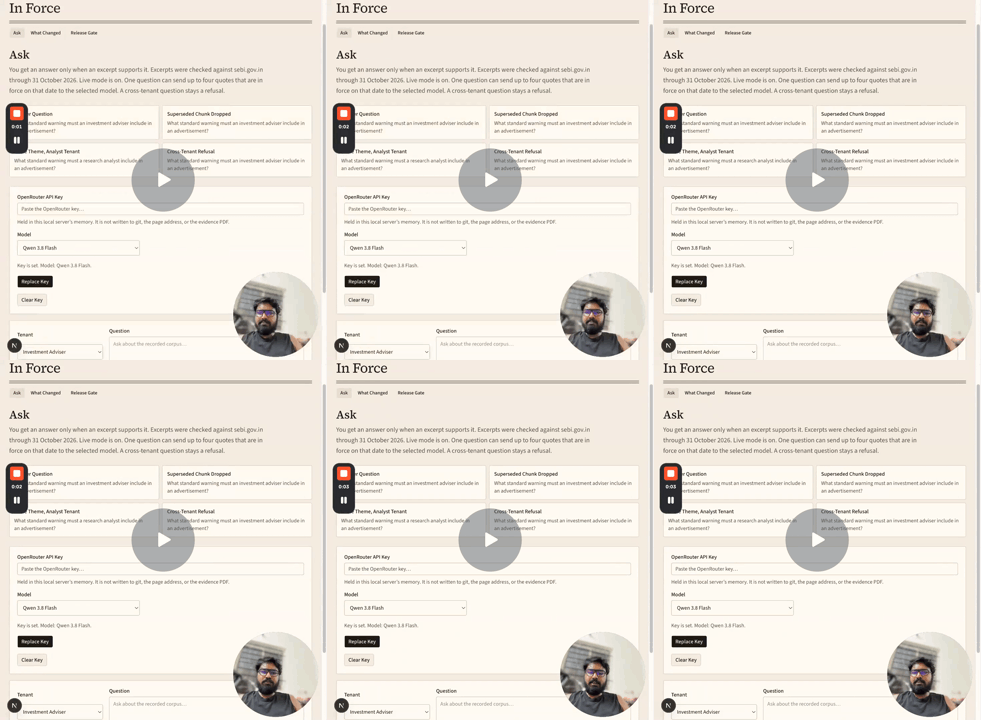
A portfolio app that answers questions from SEBI public documents, with citations from the retrieved chunks, release gating, and the token and dollar cost of each answer. Not legal advice and not a SEBI product.
Investment advisors and research analysts need answers from SEBI public documents — fiduciary duty, warning statements in advertisements, which rule was in force through 1 October, what was superseded, and the release dates. The walkthrough is a portfolio app, not a SEBI product.
Short answers grounded in retrieved chunks, with the citations beside the answer. Release gating keeps the answer on the document version that was in force. Each run shows token and dollar cost, and which chunks were dropped.
The app is not legal advice and not a SEBI product. It shows what the retrieved public documents say, with the source chunks attached.
Two read-only tools, a passing ouncemcp check, and the server running in Claude Desktop or Cursor, with the exact commands and their real output.
Six problems I kept hitting while building agents on MCP, what they cost across 840 benchmark runs, and the open-source framework I built to fix them.
Why 'RAG' is a research toy until you treat ingestion, eval, and observability as first-class concerns. Field-tested patterns from three production deployments.
Most agent loops are a symptom of bad memory contracts, not bad prompts. A short taxonomy and the four interventions that actually help.
What it actually does, when it's worth the friction, and the three places small teams should not adopt it.
Best practices for Lambda Extensions that survive prod: lifecycle, telemetry, failure modes — from six years of serverless.
End-to-end clinical AI pipeline on AWS: ingest, label, train, deploy. The boring infra decisions that decide whether the model ships.
A practical mental model for the three CDK construct levels and when each one is the right tool.
Short ops recipe — find the most recent S3 prefix and decompress on the fly inside a Databricks notebook.
Decision guide for the three AWS messaging/workflow primitives, with realistic failure scenarios.
Stand up AppSync with a Lambda authorizer using a nested-stack CDK pattern that scales cleanly.
No wildcards, no surprises — a tight bucket policy recipe in CDK TypeScript.
A no-magic walkthrough of cursor-based server-side pagination using Prisma against Postgres.
I take a small number of focused engagements, and one Production Agent Sprint slot is open for Q1 2027. The best fit is a team of 10–300 people with a working prototype, a named owner, and a deadline.