Building production-ready Lambda Extensions
Best practices for Lambda Extensions that survive prod: lifecycle, telemetry, failure modes — from six years of serverless.
Originally published on DEV · AWS Builders.
Introduction:
After six years of diving deep into serverless architectures, I’ve seen the evolution of AWS Lambda first-hand. One of the most powerful additions in recent times is Lambda Extensions. They offer a way to augment Lambda functions with custom logic, but like any powerful tool, they require careful handling to avoid pitfalls. In this post, I’ll share my insights on building production-ready Lambda Extensions with a focus on best practices, gleaned from real-world experiences.
Section 1: Understanding the Foundation – The Lambda Extension Lifecycle
-
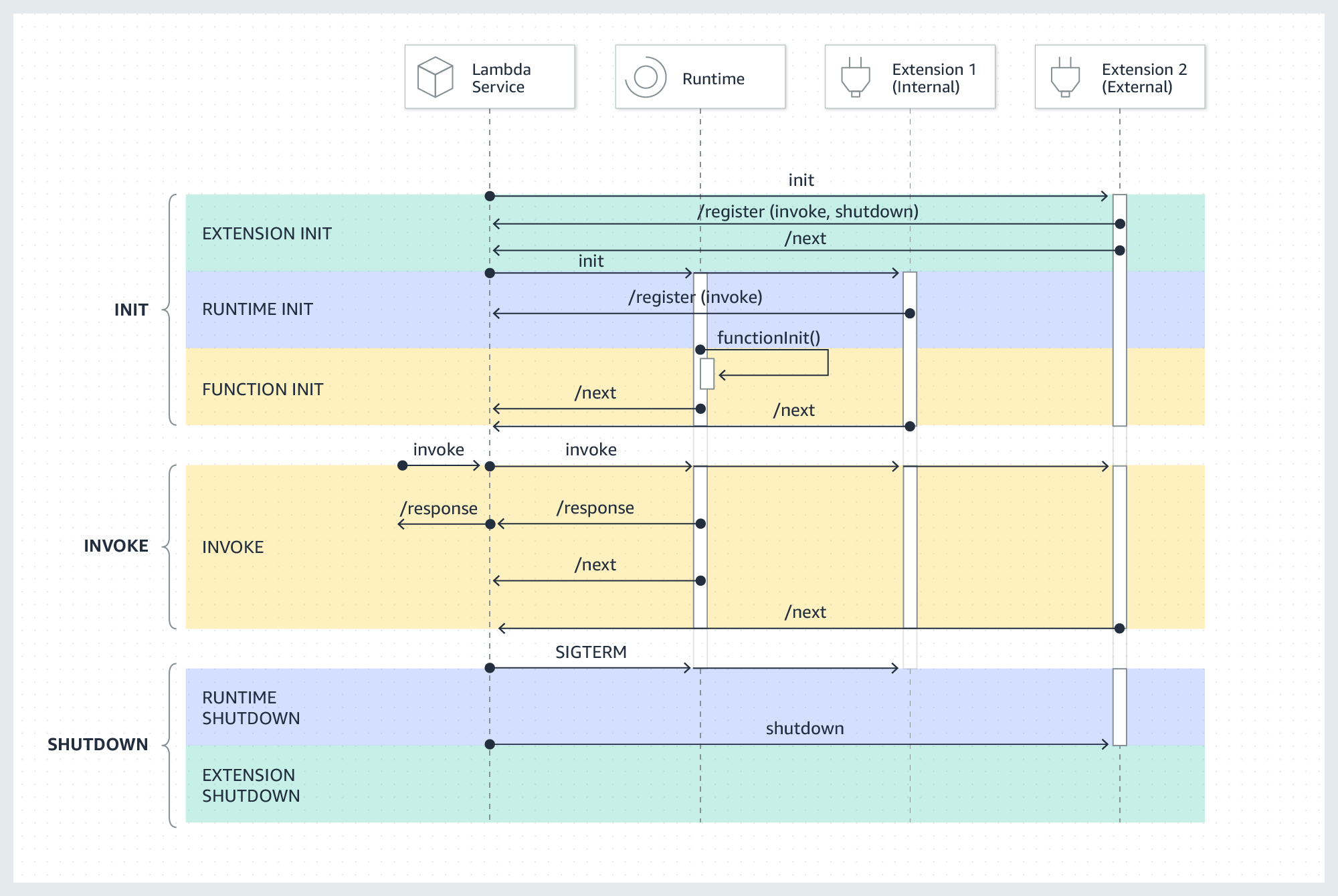
Deep Dive into the Lifecycle:
It’s crucial to understand the INIT, INVOKE, and SHUTDOWN phases.
-
Before we deep dive into practises, lets grasp the core of Lambda Extensions lifecycle which dictates how your extension interacts with the lambda function
- INIT Phase: Phase 1 where your extension get initializes. Consider this as a setup stage where you will often see configuration loading, connections to external services and necessary pre-processing happening here.
- For Example, Think like you want to use a database in your code and consider this INIT Phase as connection pool establishing which help us to use the database for any subsequent invocations.
- INVOKE Phase: Phase 2 where most of our work happens, our extension get notified when the lambda function invoked. In here, you can perform actions before, after or even during the function execution.
- For Example, A tracer extension which might capture the start and end times of the function invocation, for performance analysis.
- SHUTDOWN Phase: Final Phase of Our Extensions lifecycle, This phase will get the signal from the lambda environment when it is going to shutdown. So, that extension and wrap up its final process with the lambda function.
- For Example, A database extension which help us to create a connection with the database from lambda, in this phase it will close its connection pool and prevent the resource leaks
- INIT Phase: Phase 1 where your extension get initializes. Consider this as a setup stage where you will often see configuration loading, connections to external services and necessary pre-processing happening here.
-
Key takeaway : Understand the timing of each stage. For example, avoid heavy I/O operations during the INVOKE stage’s extension portion.
-
Internal vs. External Extensions:
Clarify the differences and when to use each type. External extensions are great for long-running processes, while internal extensions are ideal for quick, in-process enhancements.
- Internal Extension
- Run as separate processes within same lambda execution environment as the existing lambda function code. It shares same resources as the function.
- Benefits - Easy Integration , Low Latency , Simplified Observability
- External Extensions
- Run as separate processes outside the lambda function’s runtime environment
- Benefits - Long Running Tasks, Language Flexibility, Persistent Processes, Asynchronous Processing and Resource Isolation
- Internal Extension
Section 2: Building Robust and Performant Extensions – Core Best Practices
-
Language Choice and Performance:
Go and Rust are excellent choices for extensions due to their performance characteristics. Python or Node.js can be used, but be mindful of potential overhead.
- Key takeaway : Consider the performance impact of your language choice.
-
Asynchronous Operations:
Leverage asynchronous operations to avoid blocking the main Lambda function. This is especially important for I/O-bound tasks.
- Key takeaway : Avoid blocking the Lambda functions execution time.
-
Error Handling and Resilience:
Implement robust error handling to prevent extension failures from impacting the Lambda function. Use retry mechanisms and circuit breakers where appropriate.
- Key takeaway : Build extensions that are fault-tolerant.
-
Logging and Monitoring:
Comprehensive logging and monitoring are essential for troubleshooting and performance analysis. Use structured logging and integrate with CloudWatch Logs.
- Key takeaway : Observability is paramount.
-
Configuration Management:
Avoid hardcoding configurations. Use environment variables or a configuration service to manage settings.
- Key takeaway : Externalize configuration.
Section 3: Security Considerations – Protecting Your Extensions
-
Principle of Least Privilege:
Grant extensions only the necessary permissions. Avoid overly permissive IAM roles.
- Key takeaway : Minimize the attack surface.
-
Secrets Management:
Never embed secrets directly in your extension code. Use AWS Secrets Manager or Parameter Store to securely retrieve secrets.
- Key takeaway : Protect sensitive data.
-
Code Reviews and Security Audits:
Regular code reviews and security audits are crucial for identifying and mitigating potential vulnerabilities.
- Key takeaway : Proactive security is essential.
Section 4: Deployment and Versioning – Streamlining the Process
-
Packaging and Deployment:
Use AWS SAM, AWS CDK or CloudFormation to automate the deployment of your extensions. This ensures consistency and reproducibility.
- Key takeaway : Automate deployment for consistency.
-
Versioning and Rollbacks:
Implement a versioning strategy for your extensions to facilitate rollbacks in case of issues.
- Key takeaway : Plan for rollbacks.
-
Testing:
Create unit and integration tests for your extensions to ensure they function correctly.
- Key takeaway : Test thoroughly.
Conclusion:
Lambda Extensions are a powerful tool for enhancing serverless applications. By following these best practices, you can build robust, performant, and secure extensions that improve the overall reliability and efficiency of your Lambda functions. Remember to prioritize performance, security, and observability in your extension development process. I encourage you to experiment with extensions in your own projects and share your experiences.